I’ve spent enough time with Stonly’s interactive guides to understand the appeal.
Decision trees work well when a support question branches into five different directions, and the modal-style walkthroughs look sharp embedded inside a product. What’s harder to justify is everything surrounding that one feature.
Setup leans on more technical hand-holding than a plain knowledge base needs, customization tops out sooner than expected, and pricing jumps from an approachable starter plan to a custom enterprise quote almost overnight.
If any of that sounds familiar, this list covers 10 tools worth considering instead, including where each one solves the same problem differently, and where it falls short.
Why Look for Stonly Alternatives?
Stonly built a loyal following around interactive, decision-tree guides, and for the right use case, that format works. The gaps show up once a team looks past the format itself at everything surrounding it.
Setup Often Needs a Developer
Getting Stonly properly embedded, especially for in-app guides, tends to require more configuration than a team without engineering support wants to handle. That’s a genuine barrier for a smaller team that wants a self-service page live this week, not next quarter.
Customization Has a Ceiling
Beyond swapping colors and a logo, Stonly’s guides can start to look interchangeable from one company to the next. For a tool sitting directly on a product’s own interface, that sameness works against the brand consistency most teams are trying to build.
Integrations Aren’t Always Reliable
The native Zendesk connection is a known pain point, reportedly dropping every few weeks and needing a manual refresh to get working again. Slack support isn’t native either; it routes through Zapier, adding one more link in the chain that can quietly break.
Pricing Jumps Fast Past the Free Tier
Stonly’s free plan covers exactly one user. The moment a second person needs to author content, the conversation moves to a paid plan, and further still to a custom quote once a team needs the features larger organizations rely on.
10 Stonly Alternatives Worth Adding to Your Shortlist
Here’s how these 10 tools compare before the full breakdown below. None of them tries to copy Stonly’s decision-tree format outright; each takes a different route to the same goal: fewer repeat questions and faster answers.
The table gives the fast version, best fit, starting price, and Capterra rating, so you can narrow your options before reading the full entries.
| Tool | Best For | Starting Price | User Rating |
| ProProfs Knowledge Base | Structured, searchable self-service documentation and help centers | Free forever; paid from $49/author/month | 4.7/5 |
| Zoho Desk | Multi-brand help centers bundled with ticketing | Free for 3 users; paid from $7/user/month | 4.5/5 |
| Confluence | Internal teams are already running on Jira | Free for up to 10 users; paid from $5.42/user/month | 4.5/5 |
| Tettra | Slack-first teams are tired of repeating questions | Free for up to 10 users; paid from $8/user/month | 4.1/5 |
| Guru | Sales and support teams living inside Slack | Custom quote | 4.7/5 |
| Notion | Docs, wikis, and databases in one workspace | Free; paid from $10/user/month | 4.7/5 |
| Groove | Small support teams wanting an inbox plus a KB | Free trial; paid from $35/user/month | 4.7/5 |
| Zendesk | Large support orgs needing a full omnichannel suite | Paid from $19/agent/month | 4.4/5 |
| Knowmax | Contact centers that want AI-guided decision trees | Custom quote | 4.6/5 |
| Freshdesk | Budget-conscious teams needing unlimited free agents | Free for unlimited agents; paid from $19/agent/month | 4.5/5 |
1. ProProfs Knowledge Base – Best for Easiest Customer Support Help Center, Searchable Documentation & Internal Employee Knowledge Base in One
What I liked about ProProfs Knowledge Base as a Stonly alternative was that I didn’t have to map out a guided path for every question. I could focus on building useful help content and let users search for what they needed.
Creating and updating that content was quick, too. I could give AI Writer a topic, get a structured first draft, and then expand, shorten, or improve sections without rewriting them manually.
On the reader’s side, AI Search Assistant could provide a direct answer from the knowledge base instead of making users dig through multiple articles. AI Article Suggestions also surfaced relevant content without me having to anticipate every path a user might take.
I could use the same platform for public help content and private internal documentation. Roles and approval workflows helped control who could write, review, and publish, while SSO kept internal knowledge restricted to the right people.
Overall, ProProfs makes sense for teams that want to spend less time building guided flows and more time creating searchable, AI-powered self-service.
Pros:
- AI Writer drafts, expands, and rewrites full articles on command, replacing the blank-page problem
- AI Search Assistant returns one precise answer instead of a list of articles to click through
- AI SEO Optimization generates article metadata automatically, with no per-page manual work
- Standard CSS support lets non-developers restyle the help center whenever branding changes
- Role-based permissions and SSO give control over who can write, edit, and publish
- Direct integration with Chat and Help Desk moves unanswered questions into a live conversation
- Free forever for a single author managing up to 25 pages, no credit card required
Cons:
- No downloadable or on-premise version
- No dark mode
How ProProfs Knowledge Base Compares to Stonly: Stonly organizes information into branching guides that need ongoing setup to maintain. ProProfs Knowledge Base organizes it into a searchable article library instead, trading the decision-tree format for something faster to scale past a handful of guides and easier for non-technical staff to update on their own.
User Rating: 4.7/5
Pricing: Free forever (up to 25 pages, 1 author, all premium features). Essentials paid plans start from $49/author/month.
Trever Ehrlich, Creative Solutions Manager at Kenco Logistics, described their knowledge base growing to over 200 articles full of documentation, images, and video after adopting the tool, the kind of scale a decision-tree format tends to struggle to organize cleanly.

2. Zoho Desk – Best For Multi-Brand Help Centers Bundled With Ticketing
Zoho Desk fits a team that wants self-service content and ticketing living under one roof rather than stitched together from separate tools.

Its multi-brand help center feature lets a company run several differently branded knowledge bases from a single account, useful for a business managing more than one product line or customer segment.
Articles are suggested automatically based on the keywords in an incoming ticket, reducing the need for agents to type the same answer repeatedly.
Pros:
- Multi-brand help centers run several knowledge bases under one account
- Automatic article suggestions inside tickets based on keyword matching
- Community forums let customers help each other before filing a ticket
- Deep integration across the rest of the Zoho suite for teams already there
Cons:
- Customer support responsiveness is a recurring complaint in reviews
- Heavy customization of workflows often needs outside development help
How Zoho Desk Compares to Stonly: Stonly is purpose-built around interactive guides and decision trees. Zoho Desk takes a broader approach, bundling a knowledge base into a full help desk, which suits a team that wants ticketing and self-service under one login rather than a specialized guide-building tool running alongside a separate support system.
User Rating: 4.5/5
Pricing: Free for 3 users; Standard from $7/user/month
3. Confluence – Best For Internal Teams Already Running On Jira
Confluence earns a spot here for one specific reason: a team already living inside Jira gets documentation tied directly to tickets and sprints, something neither Stonly nor most other tools on this list offer natively.

Page trees keep large volumes of content organized without needing a decision-tree structure to make sense of any of it.
The tradeoff is a steeper learning curve than a purpose-built self-service tool, and styling options remain more limited than some teams expect going in.
Pros:
- Native Jira integration ties documentation directly to sprints and tickets
- Page tree structure organizes large amounts of content without a decision-tree format
- Version history with page comparisons supports accountability on every edit
- Macros add interactive elements to pages without a separate guide-building tool
Cons:
- Learning to navigate the tool takes longer than a purpose-built self-service platform
- Formatting and styling options are more limited than some competitors offer
How Confluence Compares to Stonly: Stonly guides a user step by step through a decision tree. Confluence instead organizes information into a browsable page hierarchy backed by strong search, which asks less of the person writing the content but slightly more of the person trying to find an answer inside it.
User Rating: 4.5/5
Pricing: Free for up to 10 users; Standard from $5.42/user/month
4. Tettra – Best For Slack-First Teams Tired Of Answering The Same Questions
Tettra is built around one specific workflow: a question gets asked in Slack or Microsoft Teams, and Tettra either surfaces an existing answer automatically or prompts someone to write one.

Over time, that turns repeat chat questions into a searchable library without anyone needing to remember to document anything separately.
Content that goes stale gets flagged for cleanup on its own, which keeps a growing knowledge base from turning into digital clutter nobody wants to sort through. What it doesn’t offer is co-editing; drafts move through one author at a time rather than several people writing together.
Pros:
- Slack and Microsoft Teams integration turns chat questions directly into documentation
- Automatic stale-content flagging keeps a growing library from going out of date
- Knowledge experts get routed questions automatically based on the topic
- A simple editor keeps the barrier to writing a new page low for non-writers
Cons:
- No co-editing, drafts move through one author rather than several at once
- A fair amount of setup still requires entering information manually rather than importing it
How Tettra Compares to Stonly: Stonly’s guides live independently of wherever a team already communicates. Tettra’s entire model is built around where the question was asked, usually Slack, turning that conversation into a saved answer instead of requiring someone to build a separate guide afterward.
User Rating: 4.1/5
Pricing: Free for up to 10 users; Scaling from $8/user/month
5. Guru – Best For Sales And Support Teams Who Live Inside Slack
Guru works less like a traditional knowledge base and more like a verified answer layer sitting on top of wherever a team already works.

Its browser extension captures information from any page and turns it into a card, and a Trust Score system flags when a card’s information might have gone out of date.
AI recommendations point a question toward the right internal expert when no existing card covers it. Sorting through a large card library is the spot most consistently flagged as friction once usage scales up.
Pros:
- Trust Score system flags outdated cards, so verified answers stay reliable
- A browser extension captures information from any page into a reusable card
- AI recommendations route unanswered questions to the right internal expert
- Deep Slack integration surfaces answers directly inside conversations
Cons:
- Sorting and filtering get harder to manage as the card library grows
- Custom quote pricing means no published starting rate to compare at a glance
How Guru Compares to Stonly: Stonly walks a user through a guide step by step. Guru instead pushes a single verified answer directly into the tool someone’s already using, Slack most often, which fits a fast-moving team better than building and maintaining a library of branching guides.
User Rating: 4.7/5
Pricing: Custom quote
6. Notion – Best For Teams That Want Docs, Wikis, And Databases Together
Notion earns its place here for a team whose self-service content needs to sit next to project trackers and internal databases rather than stand alone.

A support runbook can live beside a linked table tracking open edge cases on the very same page, something neither Stonly nor a dedicated help desk tool offers.
The free plan alone supports a usable small-team wiki, and pre-built templates reduce the time it takes to structure a new page. Notion AI sits behind the pricier Business plan, though, and without someone actively maintaining structure, duplicate pages tend to pile up fast.
Pros:
- Linked databases let self-service content sit next to trackers and open issues
- Free plan supports a small-team wiki, not a stripped-down trial
- Pre-built templates cut setup time for a new page or wiki
- Drag-and-drop editing keeps the document creation approachable for non-technical staff
Cons:
- Full Notion AI access is bundled exclusively into the pricier Business tier
- Navigation and the sidebar need noticeable improvement once a workspace gets large
How Notion Compares to Stonly: Stonly is a dedicated guide-building tool with a narrow focus. Notion is the opposite, a general workspace that happens to handle self-service content well, which suits a team that wants documentation, planning, and internal databases in one place rather than a specialized tool for guides alone.
User Rating: 4.7/5
Pricing: Free; Plus from $10/user/month
7. Groove – Best For Small Support Teams Wanting A Shared Inbox Plus A Knowledge Base
Groove pairs a shared inbox with a built-in knowledge base, aimed at a small support team that would rather not manage a separate ticketing tool and documentation platform side by side.

The knowledge base is mobile-optimized out of the box and can be embedded as a widget directly on an existing website.
Password protection and IP restrictions handle access control for teams that need certain content to stay private. The setup itself is approachable for a small team, though some note the platform runs pricier than expected once useful add-ons get factored into the bill.
Pros:
- Built-in knowledge base pairs directly with the shared inbox; no separate tool needed
- Mobile-optimized articles work without any extra configuration
- Password protection and IP restrictions control access to sensitive content
- An embeddable widget puts the knowledge base directly on an existing website
Cons:
- Pricing runs higher than expected once useful add-ons are factored in
- Advanced CSS customization is more limited than some competitors provide
How Groove Compares to Stonly: Stonly builds interactive guides as a standalone product. Groove folds a simpler, static knowledge base directly into a shared inbox, which suits a small support team that wants one tool for both ticket replies and self-service rather than two separate platforms.
User Rating: 4.7/5
Pricing: Free trial available; paid plans from $35/user/month
8. Zendesk – Best For Large Support Organizations Needing A Full Omnichannel Suite
Zendesk goes well beyond a knowledge base, bundling email, chat, phone, and social support into one system alongside self-service content.

Customizable themes keep the help center’s look aligned with a company’s brand, and content categories organize articles for teams large enough to require proper information architecture.
The tradeoffs are cost and complexity: pricing climbs quickly at scale, and reviewers frequently cite support responsiveness as inconsistent, given what the platform costs.
Pros:
- Full omnichannel support ties self-service content to email, chat, and phone in one system
- Customizable themes and categories support proper information architecture at scale
- Subject matter experts can be assigned to verify and update content directly
- An extensive marketplace of integrations across CRMs and collaboration tools
Cons:
- Pricing climbs quickly at scale compared to a standalone knowledge base tool
- Customer support responsiveness is a frequently cited weak point, given the cost
How Zendesk Compares to Stonly: Stonly is a focused, guide-first tool that plugs into an existing support stack. Zendesk is the stack itself, a full omnichannel suite that happens to include self-service content, which fits a larger support organization better than a team that just wants better guides sitting on top of what it already runs.
User Rating: 4.4/5
Pricing: Suite Team from $19/agent/month
9. Knowmax – Best For Contact Centers Wanting AI-Guided Decision Trees
Knowmax is the closest match to Stonly’s own approach on this list, built specifically for contact centers that want visual, AI-guided workflows rather than plain articles.

Support agents get routed through a structured decision tree to resolve issues, with generative AI assisting when a workflow isn’t a clean match for the question in front of them.
The interface is intuitive once you’re past an initial learning curve, and native-language support and deeper AI features are still catching up to demand.
Pros:
- AI-guided decision trees resolve agent questions with less manual searching
- Multimedia support combines text, images, and video inside a single guide
- Routine content checks help keep decision trees from drifting out of date
- Modular, per-agent pricing structure lets teams pay only for the pieces they use
Cons:
- Reviews on this tool are notably thinner than those of the larger names on this list
- Native-language and advanced AI feature support are still catching up to demand
- Custom quote pricing means no published starting rate to compare against other tools upfront
How Knowmax Compares to Stonly: Both tools center on visual, interactive decision trees rather than plain articles, making this the most direct like-for-like alternative on the list. The difference is audience: Knowmax is built specifically for contact center agents, where Stonly casts a wider net across onboarding, product tours, and general customer self-service.
User Rating: 4.6/5 (review counts here run smaller than the larger names on this list)
Pricing: Custom quote
10. Freshdesk – Best For Budget-Conscious Teams Needing Unlimited Free Agents
Freshdesk’s free tier stands out for one reason: unlimited agents, not just a capped handful of free seats, the way most competitors structure their entry plan.
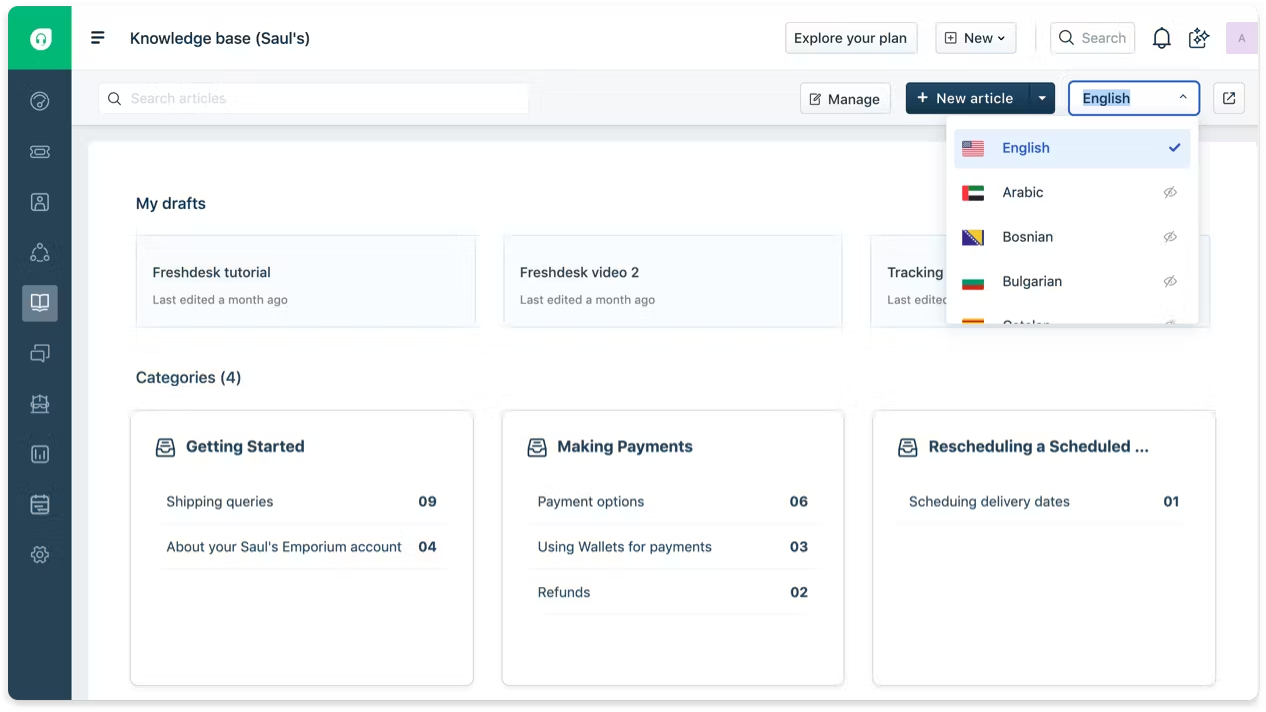
An AI-powered chatbot handles first-line questions, and support replies can be converted directly into knowledge base articles, turning ticket resolution into documentation without extra effort.
Moderation workflows keep only approved articles live, and engagement metrics show which content is getting read versus ignored. Reporting depth is the area reviewers flag most often as needing work, and support response times are described by some as slower than expected.
Pros:
- Free tier supports unlimited agents, not just a handful of free seats
- Ticket replies can convert directly into knowledge base articles
- AI-powered chatbot handles first-line questions before they become tickets
- Moderation workflows keep only approved content visible to customers
Cons:
- Reporting depth is a recurring request among reviewers
- Customer support response times are described as slower than expected
How Freshdesk Compares to Stonly: Stonly charges for every additional author past a single free seat. Freshdesk instead makes agent seats free at its entry tier and charges for advanced features instead, which changes the calculation entirely for a team that’s more headcount-heavy than feature-heavy.
User Rating: 4.5/5
Pricing: Free for unlimited agents; Growth from $19/agent/month
What Are My Top 3 Picks for Stonly Alternatives?
1. ProProfs Knowledge Base: Best for Structured, Searchable Self-Service
If Stonly’s decision trees feel like more setup than the content actually needs, this is the pick. Standard CSS support means restyling the help center doesn’t require a developer or a ticket in someone else’s backlog.
And AI SEO Optimization handles article metadata automatically, so new content surfaces in search without manual work per page.
It’s also the only tool on this list that’s free forever for a single author managing up to 25 pages, with the paid Essentials tier kicking in at $49/author/month once a second author joins, and no credit card is needed to start testing.
2. Guru: Best for Sales and Support Teams Living Inside Slack
If the problem is fielding constant one-off questions inside Slack rather than maintaining a formal guide library, Guru fits better than Stonly’s decision-tree format.
Its Trust Score system flags outdated cards automatically, so accuracy doesn’t rely on someone remembering to run a manual audit, and the browser extension turns information from any page into a reusable card in seconds.
Pricing runs on a custom quote rather than a published per-user rate, so it’s worth getting an actual number from sales before comparing it against the other tools here on cost alone, but the AI recommendation layer tends to justify the conversation for a team that leans on it daily.
3. Zendesk: Best for Large Support Organizations Needing a Full Omnichannel Suite
If self-service is only one piece of a much larger support operation spanning email, chat, phone, and social in a single system, Zendesk is built for that scale in a way a standalone guide tool like Stonly isn’t.
Subject matter experts can be assigned to verify and update knowledge base content directly, and customizable themes keep the help center aligned with a company’s brand across every channel it touches.
For a 20-agent team, Suite Team at $19/agent/month comes to roughly $380/month, a modest entry price for replacing several separate subscriptions. However, the cost climbs at higher tiers as more advanced features and channels get added, so it’s worth confirming the team’s actual channel needs before committing.
Evaluation Criteria
I evaluated the Stonly alternatives in this list based on what replaces the reason someone reaches for interactive guides in the first place: getting a customer or new hire to the right answer without opening a support ticket.
This method employs six key factors:
User Reviews / Ratings: I pulled every rating in this piece from Capterra and read past the star count into the specific complaints, since a strong average sitting alongside recurring setup or integration complaints tells a more accurate story than the number alone, especially given how often Stonly’s own reviews mention setup friction.
Essential Features & Functionality: I weighed reporting, customization depth, integration reliability, and access control more heavily than raw editing polish, because those are the exact areas where Stonly’s own users report hitting a ceiling.
Ease Of Use: I considered how much technical help, developer time, especially a team would need just to get a self-service page live, since that setup friction is one of the more common reasons people go looking for a Stonly alternative in the first place.
Customer Support: I looked at how responsive support is once something breaks, particularly around integrations, since a support tool with unreliable support of its own is a credibility problem in itself.
Value For Money: I checked whether the jump from a free or entry tier to the next pricing level buys a proportional amount of value, since Stonly’s own pricing jump past its free plan is a frequently cited frustration.
Personal Experience / Experts’ Opinions: For the tools I’ve used directly, that experience shaped what I wrote here. For the rest, I leaned on patterns that repeat consistently across independent reviews rather than any single reviewer’s opinion.
FREE. All Features. FOREVER!
Try our Forever FREE account with all premium features!
Do You Need Interactive Guides or Just Reliable Self-Service?
This is the question most Stonly alternative roundups skip entirely, and it’s the one that decides which tool fits.
If support questions branch into multiple valid paths depending on a customer’s specific situation, an interactive, decision-tree format earns its complexity.
Stonly and Knowmax both lean into that format directly, and for a complex enough troubleshooting flow, that structure can resolve an issue faster than a static article ever would.
But most self-service failures aren’t a format problem. There’s an accuracy problem: an article describing a flow that changed two months ago, or a search that returns nothing because the wording didn’t match what was typed.
If that’s the pattern behind rising ticket volume, a tool built around fast search, easy editing, and up-to-date content, ProProfs Knowledge Base solves more of the underlying problem than a fancier guide format would.
Frequently Asked Questions
What's the best free alternative to Stonly?
For unlimited free agents on a full help desk, Freshdesk's free tier stands out from the rest of this list. For free, structured self-service documentation with search and SEO handled without extra effort, ProProfs Knowledge Base is free forever for a single author managing up to 25 pages, with no credit card required to start.
Can I migrate my existing Stonly guides to a different tool?
Most competitors don't import Stonly's decision-tree format as is, since the underlying structures differ too much between platforms. What usually works instead is exporting the written content from each guide and rebuilding it as standard articles, a process most knowledge base tools, including ProProfs Knowledge Base, offer migration help for on paid plans.
Is Zendesk better than Stonly for customer support?
It depends on the scope. Zendesk covers email, chat, phone, and social support alongside a knowledge base, suited to a larger support operation running across several channels at once. Stonly focuses narrowly on interactive guides and decision trees instead. A team needing a full omnichannel platform fits Zendesk better than one that only needs better self-service guides.
Do I need decision trees, or does a regular knowledge base work?
If a support question branches into several distinct paths depending on the exact situation, a decision tree earns its added complexity. If most tickets trace back to outdated or hard-to-find articles rather than a format problem, a searchable knowledge base with strong search fixes more of the actual issue behind the ticket volume.
Which Stonly alternative works best for internal team documentation?
Confluence and Tettra both handle internal documentation well, with the deciding factor usually being whether the team already lives inside Jira or Slack day to day. ProProfs Knowledge Base also works for internal wikis that need role-based permissions alongside public-facing content, without requiring a second, separate tool to manage both.
Can Stonly alternatives handle multi-brand or multi-product help centers?
Yes. Zoho Desk explicitly supports multiple, differently branded help centers from a single account, and ProProfs Knowledge Base supports private and public sites under one login as well. Both options fit a company managing more than one product line or customer segment better than a single unbranded guide library would on its own.
How do I choose between an interactive guide tool and a standard knowledge base?
Look at where support tickets come from. If customers consistently get stuck on branching, multi-path problems, an interactive guide tool like Stonly or Knowmax helps more than a plain article would. If tickets trace back to outdated or unfindable content instead, a standard knowledge base with strong search fixes more of the underlying problem.
Does ProProfs Knowledge Base support AI-guided search as Stonly does?
Yes, AI Search Assistant returns one direct answer instead of a list of articles to click through, and AI SEO Optimization handles metadata generation without manual work, so content surfaces faster in search. It's paired with role-based permissions and SSO, built around a searchable article library rather than a branching decision-tree format.
FREE. All Features. FOREVER!
Try our Forever FREE account with all premium features!

 We'd love your feedback!
What did you like & how can we make it even better?
 Thanks for your feedback!
 Ask Your Question
Have a question? Get expert help to make your decision easier.